.
Showing posts with label novel. Show all posts

Monday, June 13, 2011

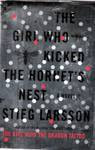
The Girl who Kicked the Hornet's Nest by Stieg Larsson: A Review


By Stieg Larsson
Copyright 2010
Publisher Alfred A. Knopf
Cost $27.95


I read and enjoyed The Girl who Kicked the Hornet's Nest but not in the same way I enjoyed Larsson's other two novels.

In this novel, we find Lisbeth Salander hospitalized following injuries she suffered at the hands of her father. But in typical Salander fashion, her father suffered equally from the damage she inflicted upon him. The novel continues where the second novel left off---with Salander accused of multiple murders. This novel however follows Lisbeth Salander as her guilt or innocence is proven and she tries to regain her life---pre-guardianship, pre-psychiatric evaluations, and pre-Zalachenko.

One thing this novel has working for it is that it is familiar. Salander is still silent but deadly. Blomkvist still sticks his nose into his stories well beyond that of a reporter. It even continues to ring of Larsson and his penchant for detail--right down to the type of sandwich his characters eat and when.

What works against this novel, and is completely different from the others, is the beginning. It opens with too much background information. The beginning of the novel consists of either a flashback in time or a description of events that occurred in the second novel. If you've already read the other two novels, like me, then the beginning tends to drag. If you haven't read the other two novels then the information will seem unnecessary in order to enjoy the book (per a friend of mine). I found myself waiting for the book to catch up to present day and take me on the adventure I knew lay in store.

And thankfully it did....eventually. And when it did, it became the page turner that made the first two novels bestsellers. Overall, I would definitely recommend the book but buyer beware you will need a dose of patience to reap the benefits of a good read.
I give it 3 1/2 stars out of 5.

Happy Reading!

I'd love to hear what you think. Have you read it? What did you think? Am I on point or completely off in space somewhere? Of course, I mean with the review. I already know I'm off in space with everything else.

Tuesday, May 17, 2011

When Do You Stop Reading?

I'm currently reading a book, which shall remain nameless, that I just can't get into. I'm on page 32 and finding it a complete chore to read. This isn't the first time this has happened to me. I have failed to connect to other books for various reasons: characters I don't care about, not enough at stake for me, or a foreign dialect or setting that the writer fails to overcome--among others. However, this is the first. time. ever. that I've actually considered not reading the rest of the book. I usually painstakingly read the entire book if I chose to take it off the bookstore or library shelf in the first place, just to see where it goes or if it gets better. The books I have had to say this to myself with in order to keep reading--don't. Get any better. But I tell myself that anyway. Otherwise, I feel a sense of failure at having given up on the book. But for the first time, I may move on to another book that should make better use of my time.

How do you feel? Can you stop reading as soon as your connection is lost with the book? Or do you keep reading? When do you stop reading--if ever?

Tuesday, March 22, 2011

Where am I now?

Much like the reality shows I love so much, I must ask myself "where am I now"? With the end of March fast approaching and a quarter of the year almost over, I thought it appropriate to see how I'm doing on my writerly New Year's resolutions.

First up, my goal to publish 5 freelance jobs this year. Status report. I've only submitted one query to one magazine for one article. Ummmm. Status update. Not good. I haven't heard back from the editor yet but I sent it less than a month ago and it takes 2 months for a reply. I'll keep you posted.

Goals 2 and 3. I wanted to edit my MS, have it critiqued and then submit it to a few agents. Status report. I haven't even finished the first draft. I have 10K more words to pen. Oy Vey. And that brings me to my next resolution.

I wanted to start and finish a rough draft of my next novel. But (in my best Sopranos impression) forget about it. I haven't even finished the first draft of my first novel.

Lastly, I want to add 100 followers to this blog. Status update. I've only added two but hey I have to start somewhere. I absolutely love the 17 followers I've got.

Some people may wonder why I'm writing about this but a status report is the perfect way to find out where you are and where you need to go. For me, where I need to go is off to write. See you later. Happy reading and happy writing.

By the way, how are you coming along with your New Year's Resolutions? Or have you completely pushed any thought of them to the back of your mind? Feel free to leave me a comment and let me know.

Monday, March 14, 2011

The Dawn Country By Kathleen O'Neal Gear and W. Michael Gear


The Dawn Country
By Kathleen O’Neal Gear and W. Michael Gear
U.S. $25.99
Copyright 2011
Historical Fiction
Published by Forge Books


Kathleen O’Neal Gear and W. Michael Gear wrote The Dawn Country as the sequel to their best-selling novel People of the Thunder. The Dawn Country continues to follow the Iroquois people of North America’s past. It tells the story of Gannajero, a witch, who buys children from the surrounding villages and sells them into slavery and many other unimaginable situations. Her story is illuminated by the brave children—Odion, Tutelo, Wrass, Zateri and others--who live in and survive captivity along with the brave warriors—Koracoo, Gonda, among others--who attempt to rescue them.

I struggled to pick up this book and start reading. Even though I love to read, the images of historical fiction deterred me. I imagined a book that read something like my high school history book, boring and utterly filled to the brim with facts. And while high school history was one of my favorite subjects, I felt no need to repeat it. However, this book was quite to the contrary. Don’t get me wrong. The novel was impeccably researched but it also possessed a captivating story somewhere between the histories of these people.

The Dawn Country was a good read. I didn’t want the story to end. It had several factors working for it—an intertwining story, an otherworldliness, and the fact that the reader does not need to read the first novel to enjoy this one.

I love when a story intertwines, following the lives of several different characters. This book does that and does it well. While the main story belonged to Odion, a child captured by Gannajero, sometimes the story followed Gannajero and her warriors then Odion, his parents and their group and at times even shadowy figures. The novel is one journey that shows how each person came to be in his or her position and a part of the story. By the end, I found myself able to sympathize with each of them.

Aside from its intertwined story, The Dawn Country also has the ability to transport its reader to a secret Native American world not only by the description of the terrain and the people but also through their plight in crossing the land and water—the way in which they did it--the tools they used and the clothes they wore. And that was only the beginning, the beliefs they held and the ways in which they chose to adapt to circumstance pushed the reader into that world.

Although The Dawn Country is the second novel in the series, it can be read and enjoyed without reading the first. The Iroquois people are the subject matter of the first novel, however, the second novel is set up in a manner that spells out everything you need to know. I never read the People of the Longhouse novel and I followed it easily. Although I do recommend not skipping the Nonfiction Introduction, it helped a lot in prefacing the novel. I can’t wait for the next novel in the series but in the meantime I have People of the Longhouse, the first novel in the series, to satisfy my appetite.

The Dawn Country is a story not to be missed. I liken the story telling to that of The Other Boleyn Girl in that the story is encased with every aspect of the time period; you leave with a better understanding of an era, a smile on your face and a story in your heart.

If you enjoyed The Other Boleyn Girl then you’ll love The Dawn Country. Go out and buy a copy today or stay tuned to my blog for a chance to win one.

Tuesday, March 8, 2011

I'm still here

I know this may be hard to believe but.....my blog is still active. Although I won't hold it against you if you don't believe me given the amount of activity on here lately. However, with my recent move from Florida to Texas this blog has been a little---actually a lot---hard to maintain. Now that my life resembles something of its former self---boxes unpacked, a routine---I can resume the blog. Up next! I'm taking part in a blog tour for the novel The Dawn Country by New York Times bestselling authors Kathleen O'Neal Gear and W. Michael Gear. Stay tuned for a possible author interview and chances to win the book along with my review of course.

Thanks for continuing to follow me. I hope to make it well worth your time.

Tuesday, January 18, 2011

To Have or Not to Have: An African American fiction section

I shopped for Terry McMillan’s Getting to Happy a few weeks ago. Initially, I had a hard time finding the book. My first instinct was to go to the fiction section but it was not there. I only found it after scouring the bookstore and making it to the African American fiction section. That experience did not stand out for me at all---that is, until I read the book.

After reading the novel, I could not see how it needed to be in any other section than fiction--perhaps, women’s fiction but fiction nonetheless. The novel dealt with menopause, divorce, children, adult children (a whole other ball of wax) and friendship. I struggled to see how those things were strictly African American in nature.

The only thing in the book slightly unique to African Americans may have been the feelings toward Hurricane Katrina and George Bush during that time. Not much else. But even with that, I don’t see how it qualifies as African American fiction because as with any other novel what you see on the page is unique to the group of people you reading about--not all people. Yes, obviously other people can relate hence the book sales. But any novel gives you an experience unique to the group of people on those pages. Not all African Americans hated George Bush because of Hurricane Katrina just like not all teenagers experience the same YA story.

Perhaps, some books qualify as African American fiction. It just seems to me that it should take more than the mere presence of African American characters---who experience the same things as any other group of people. I’m thinking books along the lines of the works of Alex Haley.

So I ask you, how do you feel---as a reader. Is there a need for an African American fiction section or not? Do you find it helpful because it tells you what to expect when you buy the book? Or do you think the topics are relevant enough to women’s fiction that it does not need a section all its own? Do you think all books written by African Americans should be in the African American fiction section or only certain ones dealing with issues unique to African Americans?

Tuesday, January 11, 2011

A review: Getting to Happy by Terry McMillan


Getting to Happy By Terry McMillan
U.S. $27.95
Copyright 2010
African American fiction
Published by Viking Peguin


Savannah
Bernadine
Robin
Gloria

Terry McMillan wrote Getting to Happy as the sequel to Waiting to Exhale. I read Waiting to Exhale back in the 90’s and saw the movie. It was one of the rare occasions in which I felt the novel actually made it to the big screen with its essence in tact. So I read Getting to Happy purely to see what the girls were up to almost 10 years later. I did not read it because I thought it would be great---sequels rarely are. They always seem to disappoint me by not living up to the original. So I merely read this book out of curiosity. Did Robin ever find a man? What happened to Bernadine and the man played by Wesley Snipes? Well, all of those questions were answered and more.

The realism worked in the novel’s favor. It started off very real. The women remained friends but hardly saw each other. I liked that. When kids and husbands come into the picture, realistically, it becomes very hard to see your friends. Getting to Happy acknowledged that. I loved Sex and the City but they unrealistically met up quite often. In Getting to Happy, the women were not able to drop everything, like they did in Sex and the City, just because one of the ladies ended up in a terrible marriage or lost their job after 18 years with the company. They were not able to all go on a vacation together at the spare of a moment. Much like women in the real world, they had jobs and obligations.

The one thing that did seem a little far fetched was the way in which the women never saw each other because of their obligations but then everything in their lives seemed to take a turn for the worse all at the same time. It appeared as if these simultaneous tragedies came along to get them to the point where they were able to see each other more often. But that depends on how you look at it. There is, after all, a reason your parents tell you to be careful about with whom you hang out---because your life tends to take the same direction as the people with whom you associate. So from that point of view it is very possible that their lives would have all taken a turn for the worse at approximately the same time.

From neither a good nor bad standpoint, Katrina played a major role. It set the time frame for the novel unlike anything else in it. Once that catastrophic event stepped foot on the pages, it became very apparent to the reader when the novel took place. Before that, it could have occurred at any point in time.

It was weird reading about a real life event in a fictional story. The whole world already knows how that played out. But more interestingly, the worldview of the event has changed. Looking back on it now, after the nation has analyzed it and given George Bush some slack, the situation presents a very different outlook. But McMillan captured the essence of how the nation, and African Americans in particular, felt at the time.

Overall, Getting to Happy gets 4 1/2 stars out of 5. Not for being revolutionary like Waiting to Exhale was back in its day but because McMillan wrote a satisfying sequel for the fans of the story line, which is not something to be overlooked.

.

Tuesday, January 4, 2011

Up Next: A Review of 'Getting to Happy' by Terry McMillan

I guess the title of this post tells you all you need to know. I'm currently reading Getting to Happy by Terry McMillan, the sequel to Waiting to Exhale. I know. Some of you are too young to have enjoyed Waiting to Exhale back in the 90's but to those of you who aren't, stay tuned for next week's review of the next chapter in the lives of Savannah, Bernadine, Robin and Gloria.

I'm on page 108 of 373.

Happy Reading!

Tuesday, December 14, 2010

A review: Harvest by Tess Gerritsen

Harvest, a medical thriller by Tess Gerritsen, follows Dr. Abby DiMatteo. She is a two year intern on the brink of getting a coveted fellowship within the transplant team at Bayside Hospital. She dates the perfect man and is well on her way to making her professional dreams come true just as a decision regarding two heart transplant patients changes everything. She ends up fighting for her job, relationship and even her life.

Tess Gerritsen wrote Harvest in 1996 but I only became aware of the novel a few years ago when an English Composition instructor encouraged my class to read the novel to get an idea of how to achieve suspense in writing. I purchased the book but did not read it until now--several years later. She was right and I could have read this good book much sooner. The suspense was only one reason to read the book; I also enjoyed the journey the main character went on and her likeability.

The opening scene alone elicits vivid imagery that makes a person cringe. It doesn't take long after that to pull the reader in. Gerritsen hooks the reader into wondering where the story is going. While the novel obviously follows the harvesting of human organs, precisely how it plays out is unknown and the novel is written in such a way that the reader finds themselves compelled to read the novel to find out just how it plays out.

I was hooked after just a few pages. I had to know what happened to Abby and even so I never knew Abby's fate---not until the very end of the novel. The novel could have been a movie with the amount of twists and turns it took.

Gerritsen wrote Abby DiMatteo into some very difficult predicaments but the more fantastic the story became the more I rooted for her. The likeability of Abby also served to hook the reader. Before I knew it, I cared about what happened to Abby and I read until I found out. I wanted her vindicated.

The only things that the novel is up against are the time, it was written in 1996, and the medical lingo. Both of which Gerritsen handled very well. Brief references to VCRs and old televisions let the reader know the time wasn't present but insert Blue Ray player and flat screen and the novel could have taken place today. Nothing else gave the decade away or took away from the story. The story could have just as easily been printed today.

I thought the medical lingo would be off-putting but it wasn’t. I only have a teeny tiny understanding of medical lingo but I followed the story and the lingo didn't loose me. I only read two passages that were over my head. I read them for an understanding of the situation without going to get lengths to decipher the medical meaning but those passages still held my attention and didn't take away from the story.

The novel was very well written and the story was compelling. I only wanted to hear more of the little boy's story woven into Abby's. The novel opened with a little boy named Yakov. He had a compelling story of his own and at least twice during the novel as I read Abby's story I wondered what was going on with Yakov. I wanted a little bit of Abby's story then a little bit of Yakov's story all the way through the novel. It read more like Yakov, Abby, Abby, Abby, and then Yakov and repeat.

All in all, however, the book is a must read and it gets five out of five stars.

Happy Reading!

Tuesday, November 23, 2010

Nanowrimo: Nearing the End

Nanowrimo takes 30 days to complete. In the end, participants have written a first draft of their novel. Each participant writes 1667 words a day for a total of 50,000 words in a month. It requires a lot of time to complete as any Nanowrimo participant can attest. Participants sacrifice if success is attained. More than a few people can probably attest to just how much sacrifice.

I participated in Nanowrimo this year and I lost track of how many hours I put into Nanowrimo weeks ago. The one thing I didn’t loose track of, however, is what I’ve given up to be a participant. While Nanowrimo provided a much needed break from some things like the laundry and dishes (they were done, just not as often as normal), I gave up some things that I can’t wait to get back to.

I have given up countless hours of sleep, reading and free time. As Nanowrimo comes to an end, I look forward to sleeping again, reading a good book, and catching up on my weekly magazine subscription. The lack of sleep is catching up to me. My characters, plot and writing goal are in my every waking thought. When my mind can process something other “Family Times” (my WIP), I plan to use my free time to catch up on my back issues of US Weekly. I haven’t read my US Weekly subscription in a little over a month (Nano prep) and I need to read my weekly news, gossip and entertainment. At this point, I’ll accept just being able to read my Twitter feed. I don’t need to read the next great American novel--any reading will be fine.

So I ask you, what have you given up to complete Nanowrimo? And what can’t you wait to get back to?

Tuesday, November 9, 2010

Am I too old for Chick Lit??

I recently read a Chick Lit book, which shall remain nameless, and found it a little difficult to relate to. I must say that experience left me a little freaked out. Chick Lit is MY genre. I read it. I write it. I get this genre---or so I thought. I know what you’re thinking---It must be the writing. But no. The author aptly wrote the novel.

The author hit all of the points of a Chick Lit novel. A Chick Lit novel is typically written from the point of view of a twenty something to a very early thirty something woman. The main character was a 25 year old female. Chick Lit typically involves the search for the perfect man, a promotion or new job—all while either looking fabulous doing it or painstakingly tipping the scales (think Bridget Jones' Diary and Confessions of a Shopaholic). The main character in this novel wanted the promotion and while not specifically pursing a man wouldn’t turn down a good one; all while being very aware of her weight. The author met the criteria for the quintessential Chick Lit novel and wrote it well enough.

I just couldn’t connect with the desire for the promotion or a man. I pursued both at one point in my life but now I feel accomplished in both of those areas. At this point in my life, I could not help but think the main character does not have any children depending on her. Priorities tend to change after children. I kept thinking if your family is okay then you can rebuild. You’re okay. If the job did not pan out for the main character she could always find another one. She’s in her twenties. In my twenties I had a billion jobs. Well, I had a lot. I’m 32 now so I sneak in just under the wire of the typical age for the main character. However, with the gnawing feeling that the stakes just weren’t high enough I find myself asking “am I too old for Chick Lit”? And I need an answer before I give my husband my Christmas list—of books he would never otherwise get me on his own.

Not to mention, I entered a contest to re-name MY genre and was selected as a semi-finalist. *insert look of disbelief here* No really. I was. Here’s the link: http://aspiringwriterworld.blogspot.com/2010/11/we-have-our-semi-finalists.html. However, to become a finalist and win the critique, among other things, I have to write a paragraph explaining why my name best suits the genre. Yes, for the genre I’m not even sure I’m suited for. Umm.

So what do you think? Have you ever read/enjoyed Chick Lit? If so, did you outgrow it or are you 80 years old still reading it?

Off I go to think about whether I’m too old for Chick Lit and why my name should be chosen for its new moniker.

Tuesday, October 19, 2010

5 Reasons to Write & Actually Finish Your Novel

Writers get a lot of rejection. From rejection letters to writing partner critiques, a writer's life is plagued with it. Understandably, a writer can find themselves believing that their writing is no good, no one will read the novel when it’s done, or a billion other untruths. Those outer, and sometimes inner, thoughts can drive a writer to stop midstream, not complete the book and give up on writing altogether. The writer's life is so plagued with rejection, in fact, that I have decided to counteract some of it. My solution? Five reasons that, despite the hills you may climb or insecurities you may feel, you should write your novel anyway.

1. Your family and friends will love your novel unconditionally. That’s why they get the prestigious title of family and friends.

2. If you love your novel, it can never be a waste of time; even if it never sells. If you love your characters and story it is well worth the journey of writing the book. If you enjoy writing the novel for one, two or three years of your life then the entertainment you provide yourself alone makes the time well spent.

3. It’s more productive than watching television. The average American spends approximately 153 hours watching television a month—writing a novel is a much better use of your time and brain. *winks* I say that as a reality television addict.

4. Twilight. Every time someone criticizes Stephenie Meyer’s writing, an angel gets its wings----and she sells another copy of her trilogy. You don’t have to be Stephenie Meyer but her story goes to show that if it seems like someone isn’t getting your story then maybe 10 million other people will. Above all, don't quit writing or believe that you can't write.

5. You are entitled to a shitty first draft. So write it already. Good, bad or ugly.

As a writer, it can seem like the competition is too stiff or your writing is not as good as someone else’s, but I just found five reasons that you should push those thoughts into some deep crevice in the back of your mind and finish your novel anyway. There’s no time like Nanowrimo!


P.S. If anyone cares, this is where I found the information on how much television Americans watch.

http://blog.nielsen.com/nielsenwire/online_mobile/americans-watching-more-tv-than-ever/